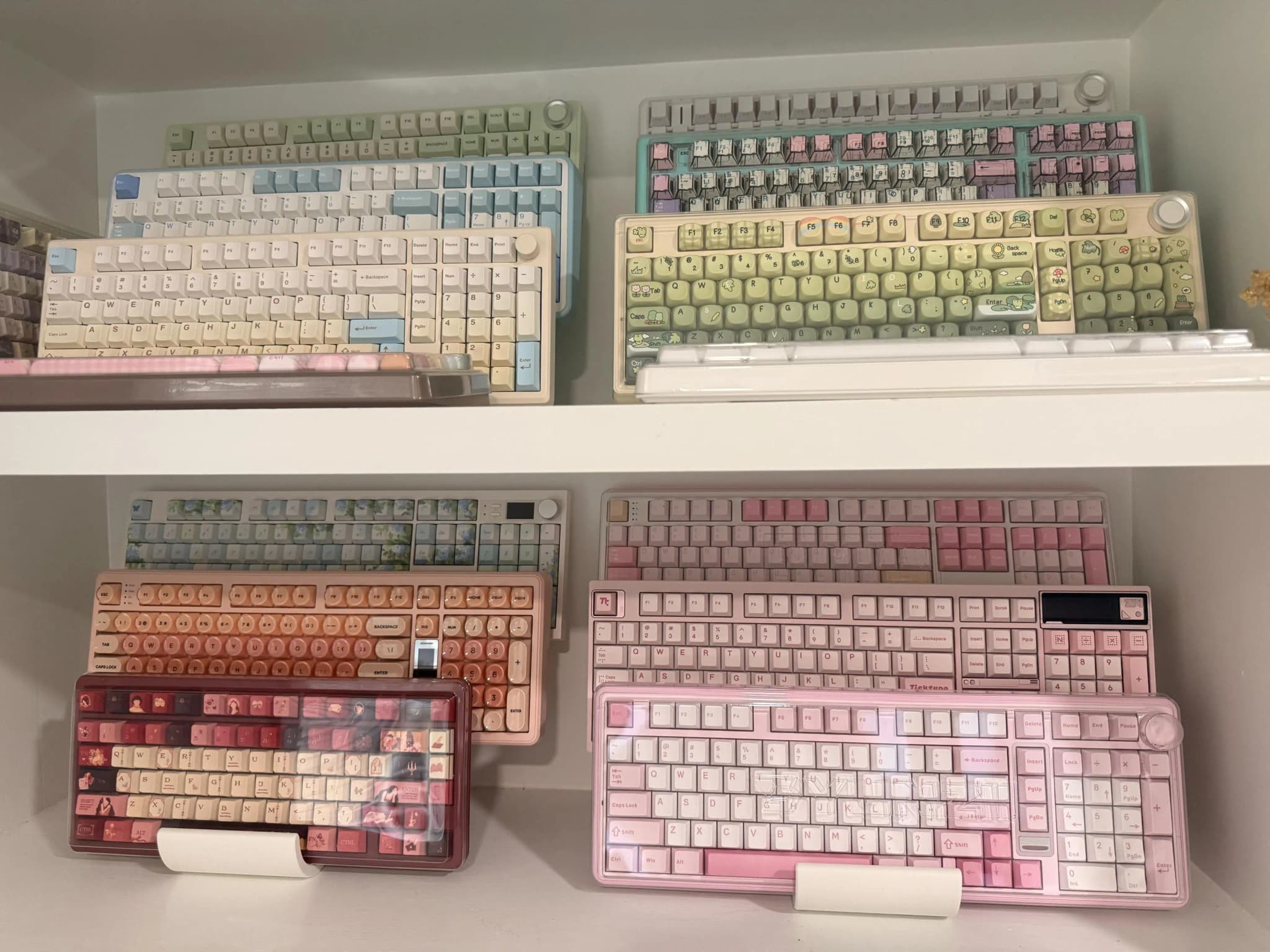
Your $500 Keyboard Deserves Better Than Sitting in a Drawer
I need to confess something. As I write this, there are seven mechanical keyboards within arm's reach of my desk. Three of them are on a display stand. One is my daily driver. And the other three? They're in a drawer. The same drawer I opened six months ago to "grab that one board for a photo" and then immediately forgot about again.
I'm in this photo and I don't like it.
If you're reading this, there's a solid chance you have your own drawer keyboards. Maybe it's one board. Maybe it's twelve. The number doesn't matter—what matters is that we need to talk about this. Because your $500 keyboard (or $200, or $800, let's not judge) deserves better than sitting in darkness while you forget it exists.
The Dirty Secret of r/MechanicalKeyboards
Let's address the elephant in the room: the mechanical keyboard community has a hoarding problem, and we've normalized it.
Scroll through r/MechanicalKeyboards on any given day. You'll see gorgeous boards photographed on artisan desk mats, bathed in perfect lighting, angled just so. What you won't see? The drawer. The box in the closet. The "keyboard graveyard" shelf we all pretend doesn't exist.
Every time someone posts their collection, there's a ritual. "Nice boards!" we comment, while mentally comparing it to our own hidden stash. "Where did you get that Keycult?" we ask, ignoring the three builds we started and never finished shoved behind the monitor.
We've created a culture where acquiring keyboards is celebrated but where the aftermath—the accumulation, the storage nightmare, the growing pile of "I'll get to it" projects—is quietly ignored.
Here's the uncomfortable truth: most keyboard enthusiasts have more keyboards than they can actually use or enjoy.
A 2023 survey on r/MechanicalKeyboards found that the average enthusiast owns 5.3 keyboards. The median? 4. But here's the kicker—only 1.8 of those are actually in regular rotation. The rest? Drawer keyboards. Closet keyboards. "I should really sell that" keyboards.
Sound familiar?
The Psychology of Keyboard Hoarding
I'm not a psychologist, but I've spent enough time in this hobby to recognize the patterns. We hoard keyboards for a bunch of reasons:
The Endgame Fallacy
We convince ourselves that each keyboard is bringing us closer to "endgame"—that mythical final board that will satisfy all our needs. But endgame is a lie we tell ourselves. It's a horizon that moves every time you approach it.
You found your perfect layout? Cool, now you need the perfect sound profile. Got that dialed? Now let's talk about flex cuts. And weight materials. And that new hall effect switch everyone's talking about.
Every keyboard was supposed to be the one. Every keyboard has a story about why it was necessary. And now every keyboard lives in a drawer, replaced by the next the one.
Sunk Cost Syndrome
"I spent $400 on this build. I can't just get rid of it."
So instead, you keep it. You keep all of them. The $400 board you overpaid for during the height of the keycap shortage. The $150 "budget build" that was supposed to be your travel board but has never left the house. The three half-built projects waiting for parts that were discontinued two years ago.
The money is already spent. Keeping the keyboard doesn't un-spend it. But our brains don't work that way, so we stuff another board into the drawer.
FOMO and Group Buys
Ah, group buys. The cocaine of the keyboard world.
"This is a limited run. Only 500 units. It'll never happen again. The resale value will be insane."
So you buy it. You wait 18 months. It arrives. You type on it for a week. And then... drawer.
Because by the time it arrived, you've moved on. New switches came out. Your tastes changed. You forgot why you wanted it in the first place. But you can't sell it because what if you regret it?
Identity and Community
Let's be honest: part of owning multiple keyboards is about identity. We're enthusiasts. Having one keyboard doesn't make you an enthusiast—it makes you a normal person. Having seven? Now we're talking.
The collection becomes a badge. Proof of our dedication. Evidence that we belong to this community. Never mind that five of those keyboards haven't been touched in a year. They exist. Therefore, we are collectors.
"I'll Sell It Someday" and Other Lies We Tell Ourselves
Let's play a game. I'm going to list some sentences, and you tell me how many you've said out loud:
- "I'll sell this once I'm done with it."
- "I'm just waiting for the right buyer."
- "The resale value isn't good right now."
- "I should photograph it first."
- "I need to clean it up before I list it."
- "What if I want to use it again someday?"
- "It has sentimental value."
- "I'll get around to it this weekend."
If you scored 4 or higher, welcome to the club. We have jackets. (They're in a drawer somewhere.)
The reality is that selling keyboards is work. You have to photograph them. Write listings. Deal with lowballers. Package them carefully. Handle disputes. For many of us, the friction is high enough that "I'll sell it someday" becomes a permanent state of being.
So the keyboards stay. They accumulate. And one day you open the drawer and realize you've got more boards in storage than some people have ever owned.
Here's the hard truth: if you haven't listed a keyboard for sale within 30 days of deciding to sell it, you probably never will.
The Case for Displaying vs Storing
Here's my pitch: stop storing. Start displaying.
I know, I know—you didn't come to a keyboard stand company's blog expecting them to recommend keyboard stands. Shocking twist. But hear me out, because this isn't about buying something. It's about changing your relationship with your collection.
Displayed Keyboards Get Used
When a keyboard is visible, you remember it exists. Novel concept, right?
I have a tiered stand on my desk with five boards. Know what happens? I actually rotate through them. Monday might be Cherry Reds. Wednesday feels like a tactile day, so I swap in the Zealios board. Friday? Linear gang with the Creams.
The keyboards in the drawer? I forget they exist for months at a time. Out of sight, out of mind—it's not just a saying, it's neuroscience.
Displayed Keyboards Are Protected (Seriously)
"But won't they get dusty?"
Yeah, a little. But here's what's happening to your stored keyboards:
- They're in a sealed environment where humidity can fluctuate wildly
- They're potentially getting compressed if you're stacking them
- They're sitting on whatever surface—case fabric, cardboard, that weird anti-static bag material
- You're not monitoring them for issues because you never look at them
A displayed keyboard accumulates surface dust that you notice and clean. A stored keyboard accumulates problems you won't discover until you finally pull it out.
Displayed Keyboards Spark Joy
Yeah, I'm going full Marie Kondo here. Sue me.
There's actual value in looking at beautiful things. Your keyboards are beautiful. The case finish, the keycap colors, the artisan you scored on mechmarket—these things bring you joy. But only if you can see them.
Every time you glance at your display, you get a tiny hit of satisfaction. I built that. I chose those keycaps. That's mine. It's a small thing, but small things add up.
What joy does a keyboard bring when it's in a drawer? None. It brings guilt. It brings the vague sense that you should do something with it. It brings clutter, even if you can't see it.
What's Actually Happening to Your Stored Boards
Okay, let's get slightly terrifying for a minute. Here's what's happening to your drawer keyboards while you're not looking:
Dust Infiltration
Even in a closed drawer, dust finds a way. It settles on keycaps. It works its way under them. It gets into switches. Over time, you're looking at scratchy switches and grimy stabilizers.
"But they're in bags!"
Cool. Bags aren't airtight. And when was the last time you checked those bags for moisture?
Humidity Damage
Humidity is the silent killer of electronics. Too low, and plastics become brittle. Too high, and you're looking at:
- Corroded contacts on your PCB
- Oxidized switch contacts (hello, chatter)
- Warped keycaps, especially PBT
- Degraded stabilizer lube
Your climate-controlled bedroom might be fine. Your closet or garage? Probably not.
Lubricant Degradation
Remember that perfect lube job you did? The Krytox 205g0 you applied with surgical precision?
Lubricants can migrate over time. They can dry out. They can attract dust particles that turn your smooth switches into gritty ones. Temperature fluctuations accelerate all of this.
The Smell
You know how keyboards can develop a smell? Usually it's just keycap legends off-gassing or case plastics settling. But in an enclosed space with no ventilation, those smells can concentrate. Nobody wants their Satisfaction75 to smell like hot plastic and regret.
Pest Interest
I hate to be the one to tell you this, but the dark, warm, enclosed space where you store your keyboards is also appealing to things that aren't keyboards. Spiders like it. Silverfish like it. In some climates, things with more legs than I want to think about like it.
Maybe check your drawer.
Display Options: From Budget to Baller
Alright, you're convinced. You want to display instead of store. Let's talk options at every budget level:
Budget Tier: Just Get Them Out ($0-30)
You don't need a dedicated stand to start. You need to see your keyboards.
- Open shelving: A simple bookshelf gets keyboards out of drawers
- DIY risers: Stack some books, create tiers, done
- Desk arrangement: Dedicate a corner of your desk to visible boards
The goal at this tier is visibility. If you can see your keyboards daily, you've already won.
Our Budget Stand fits here too—designed to be accessible without sacrificing protection.
Mid-Range: Purposeful Display ($30-60)
This is where most enthusiasts should start. A proper display stand offers:
- Cork or felt padding to protect your cases
- Tiered design to show multiple boards efficiently
- Stable construction that won't dump your collection
Our Classic Stand handles 5 keyboards comfortably and looks damn good doing it.
Premium: Show-Off Mode ($60-100+)
Ready to make a statement? Premium options include:
- Unique angles that maximize visual impact
- Premium materials that complement your boards
- Photography-ready design for content creation
The Butterfly Stand was designed for exactly this—maximum visual impact for serious collectors.
Beyond: Custom Setups ($100+)
Some collectors go full museum mode:
- Custom cabinetry with LED lighting
- Wall-mounted grid systems
- Glass display cases with humidity control
- Dedicated keyboard rooms (yes, they exist)
If this is you, respect. You've transcended drawer keyboards entirely.
The Spark Joy Test for Keyboards
Let's Marie Kondo this properly. Go pull out your stored keyboards. All of them. Pile them on your desk. Yes, right now. I'll wait.
Now, pick up each one. Hold it. Look at it. And ask yourself:
"Does this keyboard spark joy?"
Not "did it spark joy when I bought it." Not "could it spark joy if I just finished that mod I've been planning." Does it spark joy right now, as it exists?
If Yes: Display It
This keyboard deserves to be seen. Find space for it. Put it on a stand, on a shelf, somewhere you'll look at it. Use it once a week, even if just for a few minutes. Honor the joy it brings.
If No: Be Honest About Why
Maybe the joy has faded. Maybe your tastes changed. Maybe you've moved on to different switches, layouts, aesthetics. That's okay. Growth isn't betrayal.
Consider:
- Selling it to someone who will love it
- Gifting it to a friend getting into the hobby
- Trading it for something that does spark joy
- Donating it to a school or organization
The keyboard served its purpose. It taught you something about your preferences. Thank it for its service and let it go.
If "I Don't Know": Display It
Sometimes we need to remember why we loved something. A keyboard that's been in a drawer for a year might just need sunlight. Put it on display. Use it for a week. Then decide.
More often than not, seeing a keyboard again reminds you why you got it—and either you fall back in love or you realize it's time to part ways. Either outcome is healthy.
How Displaying Changed My Relationship With My Collection
This isn't hypothetical advice. I've lived this transition.
A year ago, I had thirteen keyboards. Seven were in active rotation or on display. Six were in boxes, bags, and drawers. I told myself I'd sell them. I told myself I was just storing them temporarily. I told myself a lot of things.
Then I did the exercise. I pulled everything out. I held each board. I asked the question.
Here's what I learned:
I Had Boards I'd Forgotten I Owned
There was a 60% build in a bag that I genuinely did not remember purchasing. When I found the receipt, it was from 18 months prior. I'd used it for approximately four days.
That was a wake-up call.
Some Boards Were Just... Fine
Not every keyboard in your collection needs to be special. Some of them are just fine. And "fine" isn't enough to justify drawer space or mental energy.
I sold three boards that week. Not because they were bad—they weren't. Because they weren't bringing me joy, and someone else would love them.
Displaying Changed My Behavior
Once I had a proper stand with my remaining boards visible, everything shifted. I actually rotated through my collection. I noticed when a keyboard needed cleaning. I appreciated the aesthetics I'd worked hard to create.
The keyboards became a source of daily pleasure instead of a background source of guilt.
I Stopped Impulse Buying
Here's the unexpected benefit: limited display space creates natural friction against new purchases.
When you can only display seven keyboards, buying an eighth means something has to go. That's a powerful filter. It forces you to ask: is this new board better than what I already have? Is it different enough to justify the space?
My group buy participation dropped by 80%. My satisfaction with my collection increased by about the same amount.
The Bottom Line: Free Your Keyboards
Your keyboards cost money, time, and emotional energy. They represent research, decisions, builds, modifications. They're not just electronics—they're artifacts of your hobby journey.
They deserve better than a drawer.
Here's your homework:
- Take out every stored keyboard you own
- Ask which ones spark joy
- Display the ones that do
- Find new homes for the ones that don't
- Set a display space limit and stick to it
Not because a keyboard stand company told you to. Because your collection deserves to be seen, and you deserve to enjoy what you've built.
Now if you'll excuse me, I need to go excavate my own drawer. I think there's a board in there I forgot about.
Again.
Ready to rescue your drawer keyboards? Check out our keyboard display stands—designed by enthusiasts who definitely don't have any boards in drawers. (Okay, maybe one or two.)
❓ Frequently Asked Questions
How should I store mechanical keyboards I'm not using?
The best way to store mechanical keyboards is to not store them at all—display them instead. If you must store keyboards, use individual cloth bags, add silica gel packets for humidity control, and store them in a climate-controlled environment. However, proper display stands are better for your keyboards than drawer storage, as they provide ventilation and let you monitor for issues.
Can storing keyboards in drawers damage them?
Yes, storing keyboards in drawers can cause damage over time. Poor ventilation leads to humidity issues that can corrode contacts and warp keycaps. Dust accumulation inside switches affects performance. Stacking boards can scratch cases and damage keycaps. Temperature fluctuations in closed spaces can also affect plastic components.
What's the best way to display a mechanical keyboard collection?
Tiered keyboard stands are the most popular and practical solution. They display 3-6 keyboards in the footprint of one, keep every board visible and accessible, and protect them with proper padding. Look for stands with cork or felt protection, and position them away from direct sunlight to prevent keycap fading.
How many keyboards is too many to own?
There's no magic number—the right collection size is one where you can enjoy and use all your boards. If keyboards sit untouched for over a year, you have more than you need. The key is displaying your collection so you actually rotate through and use each keyboard, rather than forgetting about boards buried in storage.
Ready to display your keyboards?
Browse our collection of premium keyboard stands, designed for enthusiasts like you.
Shop Stands